• 13 of the Biggest, Strangest, and Most Devastating Sinkholes on Earth

    One day you’re feeling satisfied with the fruits of all your yard work. The next day, your lawn is a gaping pit of mud. That’s if you are lucky – it could have been your house, neighborhood or, say, local interstate. Sinkholes tend to appear suddenly, and while particular regions are famously prone to sinkholes they happen all over the world. It begins with an innocuous leak in a rusty pipe. The earth beneath your feet quietly erodes until one day…whoosh. Whole buildings have been sucked into sinkholes. Entire roads have been knocked out. Here are some of the biggest and baddest sinkholes in the world.
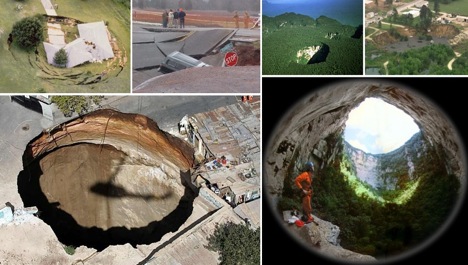
    Images (clockwise from top left): 1, 2, Google, 3, 4

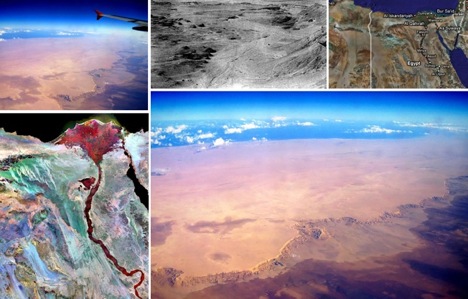
    1. Qattara Depression

    The vast Qattara west of Cairo, Egypt is the largest natural sinkhole in the world, measuring 80km long by 120km wide. This dangerous, sludge-filled quicksand pit is unearthly in its appearance and shocking in its size.

    The 133m deep sinkhole has been used in battle and more recently scientists have attempted to develop a $360 million dollar project that would harness the Qattara for complete energy independence. The plan would require digging a ditch from the edge of Qattara to the Mediterranean and allowing the sink to slowly fill with water via a tunnel. Eventually (at least 160 years in the future) the new lake would rival Lake Eerie’s size; at that point the heat of the desert would evaporate additional water flow. They’re pretty sure it would, anyway. Egypt is home to a number of desert sinkholes. The almost incomprehensibly vast Qattara hole is 100% natural – the product of fierce winds tearing into the slimy salt beds right down to the water table. (Note: click the Google Maps link to zoom. The minty-green area is Qattara.)
    Image

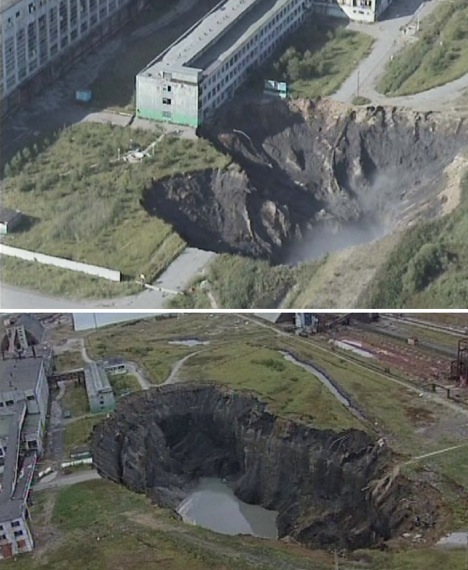
    2. Berezniki

    In Soviet Russia, the ground moves you. Berezniki’s sinkhole began in 1986 and just grows worse with each passing year. It’s unstoppable. Currently it’s over 200m deep, 80m long and 40m wide. In case you’re thinking “Berezniki? Who cares?” you should know that 10% of the world output of potash comes from this area, and the sinkhole is very close to destroying the mine’s sole rail line.
    Images

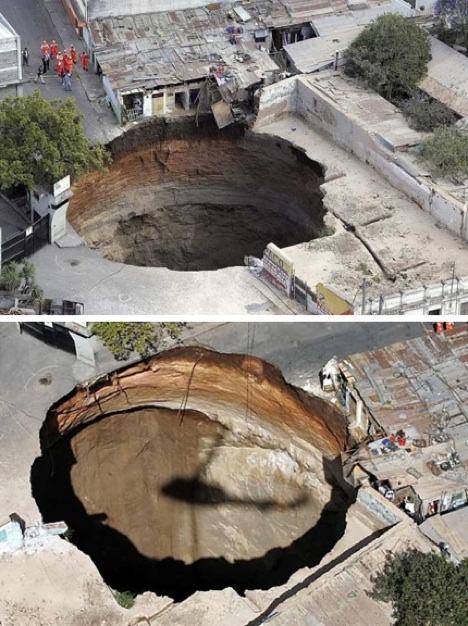
    3. Guatemala City

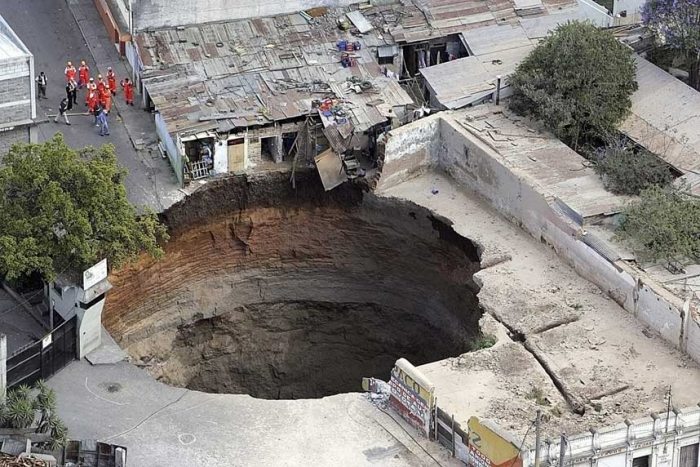
    Residents of a Guatemala City heard strange rumblings for weeks but weren’t sure what was happening beneath them. Then, in late February 2007, a near-perfect circle of earth dropped some 30 stories almost instantly. It’s amazing how neat the hole is. Two people died and over 1,000 had to be evacuated; the sinkhole resulted from a corroded sewage system deep beneath the surface (apparently the odor coming from the hole was intolerable).

    Sinkholes are caused by changing geological conditions or by a failure to maintain aging underground pipes and sewage systems, but the common factor in both is usually water. Ground underlain with carbonate bedrock – limestone for example – is most prone to sinking because the bedrock erodes with repeated exposure to water. The rock corrodes and the sediment swells with water and eventually everything reaches a critical mass point.
    Images: 1, 2, 3

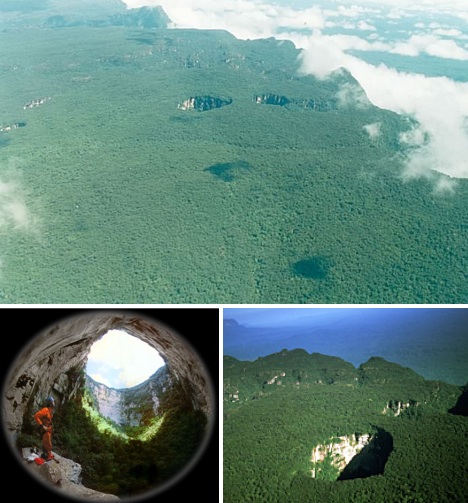
    4. Sarisarinama

    The Sarisarinama holes of Venezuela are a mysterious and beautiful natural wonder. There are several of these perfectly round basins that are each 350m in diameter and over 350m deep. Scientists aren’t sure how these stunning sink holes originated, but they are awe-inspiring nonetheless; each hole contains unique ecosystems with many distinct plant and animal species found nowhere else on earth. You can view video footage of a flight over the largest hole here.
    Image

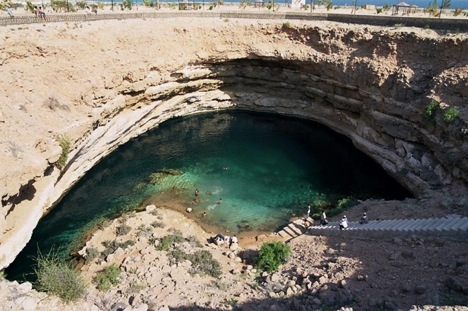
    5. Bimmah

    Making the most of one of nature’s great oddities, the residents of Bimmah, Oman turned this sinkhole into a tourist trap. (Well actually, a swim park.)
    Image

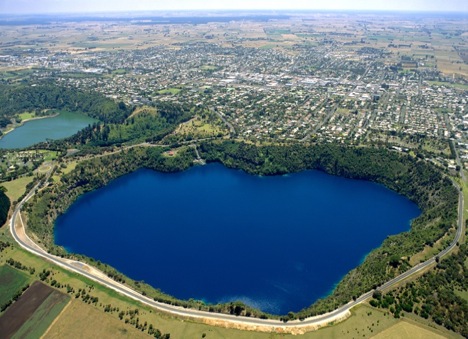
    6. Mount Gambier

    Known as the city of craters, Mount Gambier (between Adelaide and Melbourne in South East Australia) has all manner of water channels, caves and caverns beneath its residential crust. Perching atop limestone, the city has both volcanic craters and naturally-occurring sinkholes that have filled with water. It’s really quite beautiful.
    Image

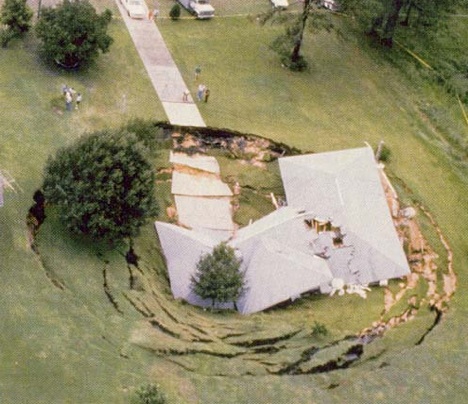
    7. Unidentified Unfortunate House

    Steve Kluge has cataloged a impressive list of geological and disaster-related photographs; you wouldn’t want to own this unlucky Florida house. (Sinkholes are a well-known and persistent problem in Florida. It’s not just floods and hurricanes.)
    Image

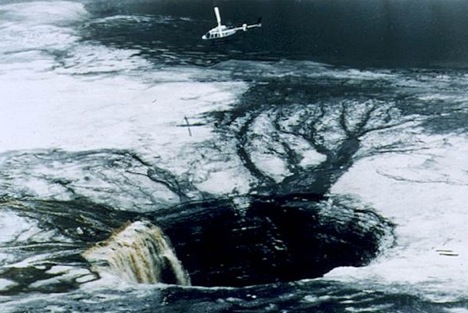
    8. Agrico Gypsum Stack

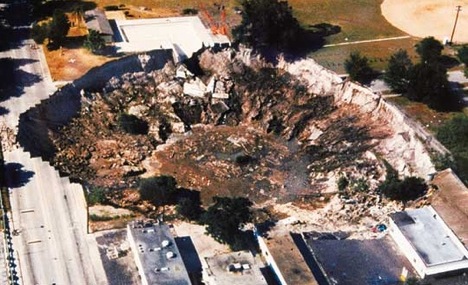
    Florida is plagued by sinkhole erosion, but this disaster in 1994 was one of the most devastating by far. A 15-story sinkhole tore open right beneath an 80-million-ton pile of gypsum stack (toxic industrial waste). The hazardous soup contaminated 90% of Florida’s drinking water and cleanup efforts ran into the millions of dollars. The 2 million cubic foot hole soon was nicknamed the “Journey to the Center of the Earth”, as if to indicate that it was the newest Disney World attraction.
    Image

    9. South Florida

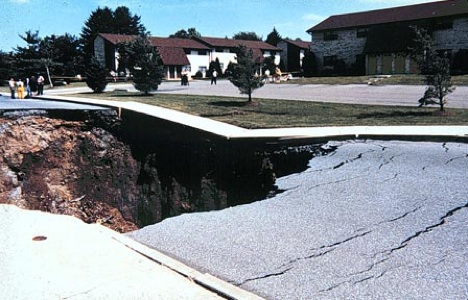
    The karst (a type of bedrock) in this urbanized Southern Florida area weakened to the point of collapse and this sizable sinkhole was the result.
    Images

    10. The Devil’s Sinkhole

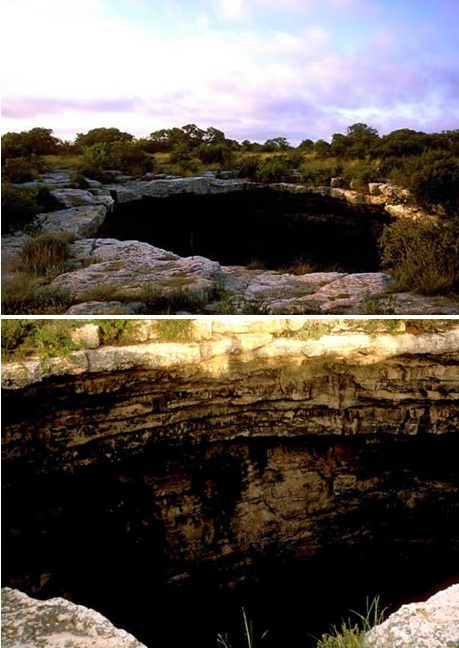
    Plunging a frightening 400 feet is the cavernous Devil’s Sinkhole in Texas. The limestone wonder has a 40′x60′ opening and there is archaeological evidence that the sinkhole was considered sacred by Native Americans. Locals are known to collect arrowheads, stalactites and other treasures from the sinkhole. Random trivia: a sinkhole may also be referred to as a swallet, cenote, or doline.
    Image

    11. Macungie

    A moderate level of water actually helps to “secure” the ground beneath our feet – otherwise we wouldn’t be able to build as the ground would simply sweep away – but if the sediment becomes waterlogged a sinkhole may strike. Though nature’s ancient sinkholes are stunning, human-caused sinks are just disastrous. The Macungie sink in Pennsylvania, above, gave Florida a run for its money. (Pennsylvania’s water system is aging, so sinkholes are becoming increasingly common.)
    Images: AP, other

    12. Daisetta

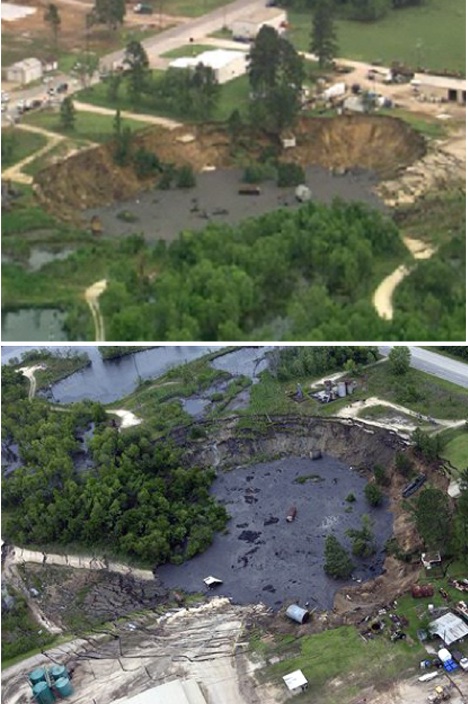
    In Daisetta, Texas just a few months ago, what started as a small 20-foot sinkhole in a residential neighborhood spread to over 900 feet within a day, consuming telephone poles, structures and vehicles as it grew. Authorities had been checking on the oil and natural gas lines as they suspected leakage. Oil field equipment nearby toppled into the pit, creating a sludge of oil and mud that came very close to destroying several homes.
    Images: Don Davis, Local Pilot

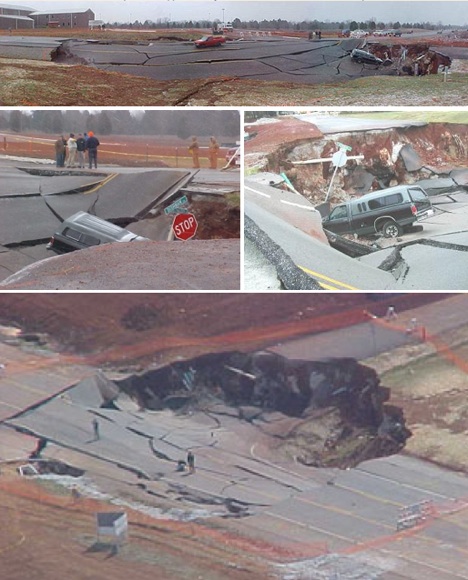
    13. Bowling Green

    Plans for the Kentucky Trimodal Transpark were quickly abandoned when this massive 200-foot sinkhole in Bowling Green, Kentucky ripped open. Unfortunately this region is dotted with naturally-occurring, numerous underground sinks that could open at any time, making development very risky in the entire area.

    With thanks to the digging done by Deputy Dog and Environmental Graffiti.

    If you are new to WebEcoist, click here to sign up for the RSS feed and take a look through our archives and galleries. Also be sure to visit WebUrbanist and see architecture, interiors, furniture and more design at Dornob.

    More Related Articles:
    • Sharing:

    • Email To Friend Subscribe
    • Email To Friend Email to Friend
    • Bookmark on Delicious Del.Icio.Us
    • StumbleUpon StumbleUpon

    Check Out These Great Related Articles:

    20 Beautiful but Critically Endangered Forests

    20 Beautiful but Critically Endangered Forests

    From the odd forest of Chile to the stretches of icy Northern rainforest to bizarre cork woods in Europe, here are the most wondrous, odd threatened forests.

    41 Comments »»

    5 Highest (Accessible) Places on Earth

    5 Highest (Accessible) Places on Earth

    Extreme altitude, highest places in the world, highest cities and villages on the planet, and most remote high altitude geographic locations on earth.

    4 Comments »»

    17 Captivating Examples of Fractals in Nature

    17 Captivating Examples of Fractals in Nature

    Fractals are a wonder - too irregular for geometry; seemingly infinite. They turn up in food, germs, plants, mountains and more. Here are 18 stunning fractals.

    31 Comments »»

    And on Other Sites See:

    29 Comments

    • User Gravatar Chris Johnston
      August 28th, 2008 at 4:09 am

      Truly frightening… yet awesome! Since so many of these are in Florida, I have to worry about Kennedy Space Center. Now I’m gonna have nightmares about the VAB or Pad 39 being swallowed up!

    • User Gravatar BCAB
      September 7th, 2008 at 11:29 pm

      Number 13, the Bowling Green Sinkhole was NOT unfortunate, but just the opposite. The planned Trimodel Airport Park was a boondoggle for greedy developers. This so called “Park”, seriously threatened Mamouth Cave, the world’s largest cave, and a World Heritage Site. This sinkhole saved Mamouth Cave, at least for the time being.

    • User Gravatar SoD
      September 9th, 2008 at 5:05 am

      Consider this sinkhole explanation

      Though some sink holes are caused by careless deeds of people, or maybe a natural and explainable cause … many of the circular sinkholes occur because of a solid object that was once there in no longer in place … There are more things going on around us than governing forces would like us to know … ask yourself these questions … why now are so many “so called corrosions of water” falling in as sink holes around the same time ?. Some are claiming to be caused by heavy rain, other by broken water mains. Coincidence? Or Convenient Cover-ups?

      The people should now be allowed to know …. just how much Ancient Objects of advanced technology are associated with some of Earth’s so called “natural Disasters” … just as the people should be allowed to know of the altered frequency veil surrounding this planet is about to shift back …. and that the great shift in Earth’s frequency will reestablished Earth link with an original Celestial Alignment of Colonies which are associated with an Original Ancient Satellite Host referred to as the True Christ-light-Star.

      And as for sinkholes …. The people should know that some Ancient Crafts and Facilities have long settled just beneath earth’s surface …. some very deep below surface …. And that the bigger the craft or object which once settled, the bigger the sinkhole had appeared when they were plucked away … Scripture and science are coming together … the plucking away of these Objects are evidence of the Second Celestial Resurrection.

      People must at the least be given the opportunity to consider this plausible explanation !!!!

      Nothing to sell … Nothing to Buy … just answers to the many MYSTICAL ’WHYs?’ evelynseedofdavid2012@yahoo.com
      http://sod2008.multiply.com
      be well … be safe … be aware !

    • User Gravatar Jess
      September 12th, 2008 at 5:14 am

      @SoD

      Hahahahahahahahahahahahahaha!

      Thanks for that, that made my day!

      I’m assuming its a joke, otherwise, I feel sorry for the people you know.

    • User Gravatar mikey
      September 23rd, 2008 at 3:29 am

      jess, why are you so damn retarded?

    • User Gravatar chrisb
      September 25th, 2008 at 7:32 am

      Nevermind all of the sinkholes in and around Baltimore starting off with the one on Howard St. in the late 90’s. If I remember right, it took a few days to fill the intersection. There’s been a new one collapsing every few years in all sorts of old, established areas.

    • User Gravatar website design
      September 26th, 2008 at 8:27 pm

      Amazing photos. The sinkhole at Berezniki looks unbelievable- it’s hard to imagine something that big suddenly appearing in your street!

      QFA:”Berezniki’s sinkhole began in 1986 and just grows worse with each passing year. It’s unstoppable. Currently it’s over 200m deep, 80m long and 40m wide.”

    • User Gravatar Wix
      September 29th, 2008 at 5:43 am

      The photo for Mt Gambier shows two lakes, Blue Lake and the smaller Valley Lake, both are Volcanic Crater Lakes. However the surrounding area has many dry and waterfilled sinkholes, including beneath the town itself, many of which can be accessed for cave diving.

    • User Gravatar gmin
      October 15th, 2008 at 4:57 pm

      Would like to know if these sinkholes gradually develop into quick sand pits.?

    • User Gravatar CocoBean
      November 20th, 2008 at 7:12 pm

      Woah, Awesome! (and also not so awesome)

    • User Gravatar Irene Trube
      December 3rd, 2008 at 1:30 am

      Pretty scary. We have lived in Washington, New Jersey 07882 for over 35 years and always had small holes developing in the driveway so we just didn’t pave it but all of a sudden after a long rain we got a big one in the yard, a little too near to the house. Every rain it gets bigger and we are getting nervous. Seems to be no end to it. Seems it can happen any time and anywhere to anyone. Our neighbors lost half their yard including the swingset, which thankfully was not being used at the time.

    • User Gravatar pippy
      December 10th, 2008 at 9:16 am

      this is just scary

    • User Gravatar Dr. Rocks
      December 24th, 2008 at 10:37 am

      The Quattra depression isn”t really a “sinkhole” though it might considered a sink, i.e. a former lake basin like Death Valley or the Dead Sea. Filling it with salt water would cause some huge changes in the climate of the Sahara desert, It would be a great experiment.

      Also karst is a process of dissolution of rock not a type of bedrock. In Florida the bedrock is limestone, which is soluable in fresh water. Water dissolves caves and the caves collapse creating sinkholes. Karst is the process named for region in the Balkans (former Yugoslavia) but the process occurs in many regions, notably Central America and southeast China in the Gaulin Province and in the northern part of Vietnam adjacent to the Chinese border.

    • User Gravatar PRJ1553
      December 26th, 2008 at 2:19 pm

      This sinkhole does not rival the ones you have featured on this page, but it is uncanny how it managed to open up directly underneath the only car in the vicinity.

    • User Gravatar Kiplie
      April 20th, 2009 at 1:31 am

      Stop illegal loging, stop air polution!!
      safe life on earth day april 22th.

    • User Gravatar Kiplie
      April 20th, 2009 at 1:38 am

      Stop illegal loging, stop air polution!!
      safe life on earth day april 22nd.

    • User Gravatar Kiplie
      April 20th, 2009 at 1:40 am

      Stop illegal loging, stop air polution!!
      safe life on earth day april 22nd.

    • User Gravatar Kerem AVCI
      June 24th, 2009 at 12:40 pm

      Hi guys. I am a geologist in Turkey and unfortunately we have the same problem in Konya city. We have huge sinkholes like the ones shown above. We are now anaylsing those structures in order to prevent a probable danger to people. The most important mistake made here in Turkey is the excess pumping of farmers. So the water table reduces drastically that results in sudden failure of carbonate rocks. Farmers must use the water carefully. They shouldnt irrigate the soil excessively but should use modern techniques and decrease the water amount used for watering.

    • User Gravatar Kerem AVCI
      June 24th, 2009 at 12:42 pm

      Hi guys. I am a geologist in Turkey and unfortunately we have the same problem in Konya city. We have huge sinkholes like the ones shown above. We are now anaylsing those structures in order to prevent a probable danger to people. The most important mistake made here in Turkey is the excess pumping of farmers. So the water table reduces drastically that results in sudden failure of carbonate rocks. Farmers must use the water carefully. They shouldnt irrigate the soil excessively but should use modern techniques and decrease the water amount used for watering. I am open to all scientists who are concerned with this problem and anyone can reach me throuh my email address to ask me anything about the sinkholes in Turkey. Best regards.

    What do you think? Leave a comment!


    Visit Our Partner Sites: